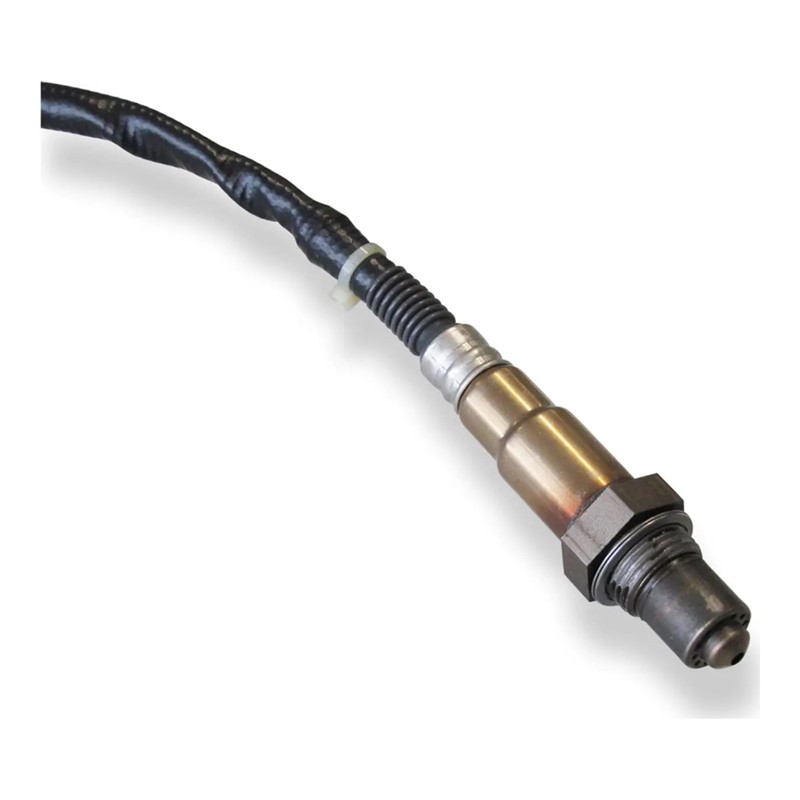
Oxygen Sensor, Lambda Sensor LSU 4.9
$84.94
per EACH (USD)0258017025
Bosch LSU 4.9 wideband O2 sensor, 0 258 017 025
Genuine Bosch LSU 4.9 wideband lambda sensor, Bosch 0 258 017 025. M18x1.5 thread, 6-pin connector, 95 cm lead. Works with the Racetronix AFRG1 air/fuel ratio gauge and other LSU 4.9 controllers.
The LSU 4.9 is Bosch's wideband oxygen sensor: a planar zirconia dual-cell sensor with its own heater. It reads the exhaust from lambda 0.65 (very rich) all the way to free air, so it serves for tuning, data logging and closed-loop fuel control. The connector holds a trim resistor, set by Bosch for each sensor, which defines its characteristic.
Key features
- Genuine Bosch, part number 0 258 017 025 (Bosch US 17025).
- Wideband: lambda 0.65 to free air (AFR about 9.6 to free air on gasoline).
- Accurate: lambda 1.016 ± 0.007 at stoichiometric, 0.80 ± 0.01 rich, 1.70 ± 0.05 lean (Bosch).
- Gasoline, diesel and E85 compatible.
- Built-in heater (7.5 W steady state) brings the sensor up to working temperature quickly, even at idle.
- Factory trim resistor in the connector: each sensor is calibrated by Bosch.
- Stainless steel body, double laser-welded, with a 22 mm hex and M18x1.5 thread: fits any standard O2 sensor bung.
- Handles the heat: exhaust gas up to 930 °C (1,706 °F) continuous and 1,030 °C (1,886 °F) for short periods.
Current production may vary slightly from the photos.
Specifications
| Bosch part number | 0 258 017 025 (Bosch US 17025) |
| Type | Planar ZrO2 dual-cell limiting-current sensor with integrated heater |
| Measuring range | Lambda 0.65 to ∞ (free air) |
| Fuels | Gasoline, diesel, E85 |
| Accuracy | Lambda 0.80 ± 0.01; 1.016 ± 0.007; 1.70 ± 0.05 |
| Exhaust gas temperature | Up to 930 °C (1,706 °F) operating; 1,030 °C (1,886 °F) short term |
| Hex temperature | Up to 600 °C (1,112 °F) |
| Lead and sleeve temperature | Up to 250 °C (482 °F) |
| Connector temperature | Up to 140 °C (284 °F) |
| Exhaust gas pressure | Up to 2.5 bar (36 psi); higher with reduced accuracy |
| Heater | 7.5 V nominal (H+), 7.5 W steady state, control frequency ≥ 100 Hz |
| System supply voltage | 10.8 to 16.5 V |
| Nernst cell | 300 Ω nominal resistance; 250 µA maximum current |
| Vibration | 300 m/s² (stochastic peak level) |
| Storage temperature | −40 to 100 °C |
| Thread | M18x1.5 |
| Hex (wrench size) | 22 mm |
| Tightening torque | 40 to 60 N·m (30 to 44 lb-ft) |
| Weight | 75 g (2.6 oz) without the lead |
| Lead | 95 cm (37.4 in), fibreglass sleeve with silicone coating |
| Connector | 6-pin Bosch automotive connector (Bosch 1 928 404 687); mates with Bosch D 261 205 356-01 |
| Interface | Needs an LSU 4.9 controller (Bosch LSU interface IC), such as the one in the Racetronix AFRG1 gauge |
| Datasheet | Bosch Motorsport, Lambda Sensor LSU 4.9 (January 2026) |
| Part number | 0258017025 |
Connector pins (Bosch)
| Pin | Function |
|---|---|
| 1 | Pump current (APE / IP) |
| 2 | Virtual ground (IPN / VM) |
| 3 | Heater − (H− / Uh−) |
| 4 | Heater + (H+ / Uh+) |
| 5 | Trim resistor (RT / IA) |
| 6 | Nernst voltage (UN / RE) |
Lambda, AFR and pump current
Bosch's characteristic for the LSU 4.9: the pump current at each lambda value, with the matching gasoline air/fuel ratio.
| Lambda | AFR, gasoline | Pump current Ip (mA) |
|---|---|---|
| 0.650 | 9.6 | -2.000 |
| 0.700 | 10.3 | -1.602 |
| 0.750 | 11.0 | -1.243 |
| 0.800 | 11.8 | -0.927 |
| 0.822 | 12.1 | -0.800 |
| 0.850 | 12.5 | -0.652 |
| 0.900 | 13.2 | -0.405 |
| 0.950 | 14.0 | -0.183 |
| 0.970 | 14.3 | -0.106 |
| 0.990 | 14.6 | -0.040 |
| 1.003 | 14.7 | 0 |
| 1.010 | 14.8 | 0.015 |
| 1.050 | 15.4 | 0.097 |
| 1.100 | 16.2 | 0.193 |
| 1.132 | 16.6 | 0.250 |
| 1.179 | 17.3 | 0.329 |
| 1.429 | 21.0 | 0.671 |
| 1.701 | 25.0 | 0.938 |
| 1.990 | 29.3 | 1.150 |
| 2.434 | 35.8 | 1.385 |
| 3.413 | 50.2 | 1.700 |
| 5.391 | 79.2 | 2.000 |
| 7.506 | 110.3 | 2.150 |
| 10.119 | 148.7 | 2.250 |
Bosch data. Only the pump current Ip tracks the oxygen in the exhaust; the controller turns it into the lambda or AFR reading. AFR = lambda x 14.7 for gasoline (E85 is about 9.8 at lambda 1).
How to install it
- Mount it near vertical, wire end up, and at least 10° above horizontal so condensation drains off the tip (Bosch). Never mount it pointing up from underneath the pipe.
- Where: where the exhaust is as hot as possible but within the temperature limits above, typically in the collector or downpipe ahead of the converter. Keep it away from the tailpipe outlet, where outside air affects the reading.
- No exhaust leaks ahead of the sensor: leaks draw in air and make the reading lean.
- Turbocharged: mount it after the turbo, where the exhaust pressure stays under 2.5 bar.
- Condensation: start the engine first, or power the controller, so the heater does not run while water is condensing on a cold sensor; cold water on a hot ceramic element can crack it.
- Thread: M18x1.5, torque 40 to 60 N·m (30 to 44 lb-ft). The thread comes pre-coated; if you reuse the sensor, use only a high-temperature sensor thread compound on the threads. Do not paint, wax or coat the sensor.
- Bung: Bosch recommends at least 10.5 mm of M18x1.5 thread and a flat 25 mm boss. Our weld bungs below are made for it.
- Never run the engine with the sensor installed and the controller off: soot builds up on an unheated sensor and shortens its life.
Gauge, harness and bungs
| Part | Image | What it is |
|---|---|---|
| AFRG1 | 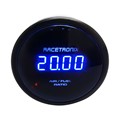 | Wideband air/fuel ratio gauge Digital LED AFR gauge with its own LSU 4.9 controller. Works with this sensor. |
| O2EXT- WBLSU | 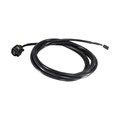 | 3 m extension harness Extends the sensor lead to the gauge. |
| FIT- BUNGM1815MS | 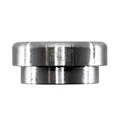 | M18x1.5 weld bung, mild steel For mild steel exhaust pipes. |
| FIT- BUNGM1815SS | 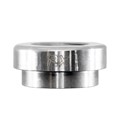 | M18x1.5 weld bung, stainless steel For stainless steel exhaust pipes. |
Questions and answers
Is it a genuine Bosch sensor?
Yes. It is the Bosch LSU 4.9, part number 0 258 017 025, the same sensor used in original equipment and in most wideband controllers.
Will it work with my other wideband gauge or controller?
It is the standard LSU 4.9, so it fits controllers built for the LSU 4.9 with the same 6-pin connector. If your controller is made for the LSU 4.2 or another sensor, it will not work.
Can it replace an LSU 4.2 sensor?
No. The LSU 4.2 uses a different connector and needs a controller made for it. Check which sensor your controller is designed for.
Does it work with E85?
Yes. Bosch rates it for gasoline, diesel and E85. The sensor measures lambda; an AFR display is scaled for one fuel, so on E85 read lambda or convert (lambda 1 is about 9.8:1 on E85, 14.7:1 on gasoline).
Why is my new sensor reading lean?
Usually an exhaust leak ahead of the sensor, the sensor too close to the tailpipe, or a sensor mounted where exhaust pressure is high. See the installation notes.
Can I return it?
Not once it is opened. Sensors cannot be checked for use or contamination, so we do not accept returns or warranty claims on opened sensors.
Warranty and support
No returns or warranty on opened sensors. Check that your controller is made for the LSU 4.9 before you order.
Not sure it fits your controller? Email [email protected] before you order.
Racetronix provides technical support to verified customers through our support forum, not by phone or email. Please request forum access when you place your order so your account is approved before your parts arrive. The forum is moderated, open 24/7, and holds a knowledge base going back to 1999.